
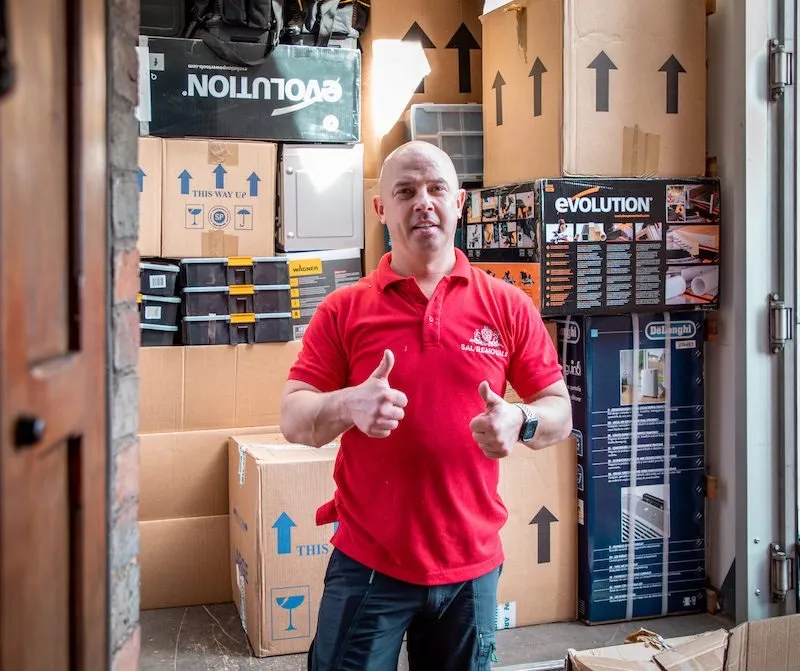

Why declutter before moving house?
Because everything you keep, you pay to pack, carry, transport and unpack. Removal firms price on volume and time, so every box you do not fill takes a little off the job. Downsizing to a smaller home makes it essential rather than optional: the furniture has to fit the new rooms, not the old ones.
There are gains beyond the price. Packing is faster, moving day is shorter and less tiring, and you unpack into a home that holds only what you use.
How do I decide what to keep?
Take each item in your hand and ask these questions in order. Two or more “no” answers and it goes.
- When did I last use it? If it has not been used, worn or looked at in a year, you are unlikely to miss it. The one-year rule covers a full cycle of seasons, so it catches the coat you only wear in winter.
- Do I really need it, or could I live without it? Be honest. Most of us use a small share of what we own most of the time. Keep that share.
- Would I buy it again today? If you would not pay for it now, it is only here because it was here before.
- Does it fit the new home? Measure the new rooms, doorways and stairs. A sofa that fits a through-lounge in a semi may not turn into a flat’s hallway.
- Does it cost more to move than to replace? Cheap flat-pack furniture, old cleaning products and bulk food often do.
- Do I own more than one? Keep the best of any duplicate set and let the rest go.
Sentimental items are the exception to the rule. Keep a small, chosen set and photograph the rest before you let them go: the memory stays, the box does not. Do not make these decisions in the last week, when you are tired and everything feels important.
Where should I start decluttering?
Start with the rooms that hold the most and are used the least: the loft, the garage, the shed, the spare room and the cupboard under the stairs. They take longest to sort and rarely hold anything you need before the move.
Then work room by room through the rest of the house:
- Living room: keep the furniture you use every day, and favour pieces that do two jobs if the new place is smaller.
- Kitchen: keep what you cook with each week. Appliances that sit in a cupboard, duplicate pans and out-of-date food go.
- Bedrooms: clothes not worn in a year, spare bedding beyond two sets per bed, and toiletries you never finish.
- Bathroom: basic toiletries and cleaning supplies only.
- Home office: shred old paperwork you do not need to keep, and recycle dead cables and chargers.
Work in short sessions, one drawer or one cupboard at a time, and finish each space before starting the next. A half-sorted room looks worse than it did before you began.
How long does decluttering take? A timeline
| When | What to do |
|---|---|
| 8 weeks out | Loft, garage, shed and spare room. List large items for sale. |
| 6 weeks out | Book a charity collection or clearance for anything big. Sort books, toys and hobby kit. |
| 4 weeks out | Bedrooms and wardrobes. Decide what goes into storage, if anything. |
| 2 weeks out | Kitchen and bathroom. Use up food and toiletries rather than packing them. |
| 1 week out | Final sweep. Last charity drop, last recycling run, collect sold items. |
| Moving week | Nothing new comes into the house. Pack only what passed the test. |
Keep a simple list of what has been sold, donated or booked for collection, so nothing is still waiting in the hallway when the van arrives. For the rest of the countdown, the moving house checklist picks up where this timeline stops.
Sell, donate, recycle or clear: which route for what?
| Route | Best for | Things to know |
|---|---|---|
| Sell | Furniture in good condition, electronics, branded clothes, bikes | Start early, since buyers take time. Local selling apps and marketplaces avoid delivery. |
| Donate | Clothes, books, toys, kitchenware, usable furniture | Charity shops take small items. Charity furniture collections usually need fire safety labels on upholstery. |
| Recycle | Cardboard, electricals, metal, garden waste | Council recycling centres are free for residents, but most restrict vans and refuse trade waste. |
| Clear | Bulk, broken or mixed items, whole rooms | Use a registered waste carrier and ask where the waste goes. |
Selling works best for anything you would be pleased to buy second hand. Photograph it in daylight, price it to go, and set a date after which it is donated instead. Money from sales can cover a good part of your moving costs.
Donating keeps usable things in use. Bag clothes and books by type, and book furniture collections early, because charity collection slots fill weeks ahead.
Recycling at your council’s centre is free if you have a car and can prove you live in the borough. In North London the rules vary: Barnet’s Summers Lane centre asks vans to book 24 hours ahead, and Brent’s Abbey Road centre treats vans as trade, so check your council’s page before loading up.
Clearing is the answer when there is too much, it is too heavy, or time has run out. Whoever takes it away must be a registered waste carrier. If they are not and your rubbish is fly-tipped, you can be held responsible. Our guide to waste disposal and house clearance explains what happens to cleared items, and how house clearance works walks through a typical job.
How does decluttering lower the cost of a move?
A removal quote is built on how much there is and how long it takes to move it. Take less and three things shrink at once:
- The vehicle. A two-bed flat usually fits in one Luton van. Trim a three-bed’s worth of belongings and it may fit the same van, where a full load would typically need two.
- The hours. Fewer boxes means less time carrying down stairs and along pavements, which matters when you are paying by the hour.
- The packing. Fewer boxes to buy and fewer to fill, whether you pack yourself or pay for a packing service.
Clear out before anyone comes to survey or quote, not after. A quote given on a full house prices in everything you plan to get rid of.
Other ways to move on a budget
Decluttering is the biggest saving, but a few more add up:
- Pick a quieter date. Weekdays and the middle of the month are usually less busy than Fridays, weekends and month ends, when most tenancies and completions fall.
- Get boxes for free. Ask friends who have just moved and local shops, and use suitcases, laundry baskets and drawers as containers. Buy sturdy boxes only for heavy and fragile things.
- Pack yourself. Leave only the fragile items to professionals if you are unsure. Our packing guide and these space-saving packing hacks help you fit more into fewer boxes.
- Book the right size of help. A small, well-sorted load often suits a man and van by the hour rather than a full crew.
- Compare like with like. When you compare quotes, check each one covers the same volume, crew, time and insurance.
More general advice is in moving house tips and advice.
When to call in help
If the declutter leaves you with a garage of things nobody wants, our house clearance team clears a single room, garage or loft from £149, and our waste removal service collects single items from £69. We are a registered waste carrier (CBDL469340). Things you are keeping but have no room for can go into storage from £20 + VAT a week per container. Once the load is down to what matters, a man and van starts from £69 per hour, with a two hour minimum, and full house removals start from £449 for a one-bed home. Every job is priced individually, so these are starting points, not a quote.
Call 020 3475 0377 or get a free quote for your move.